
Whether you’re buying a used Honda Civic from a neighbor or selling your old car through an online listing, one document stands between a smooth transaction and a potential legal headache the car bill of sale.
In Ontario, a car bill of sale isn’t just a formality. It’s a critical piece of paperwork that protects both the buyer and the seller. Yet many private vehicle transactions happen without one or with an incomplete version that offers little legal protection.
This guide breaks down exactly what an Ontario car bill of sale is, what it must include, why it matters, and how to get it right every single time.
What is a Car Bill of Sale?
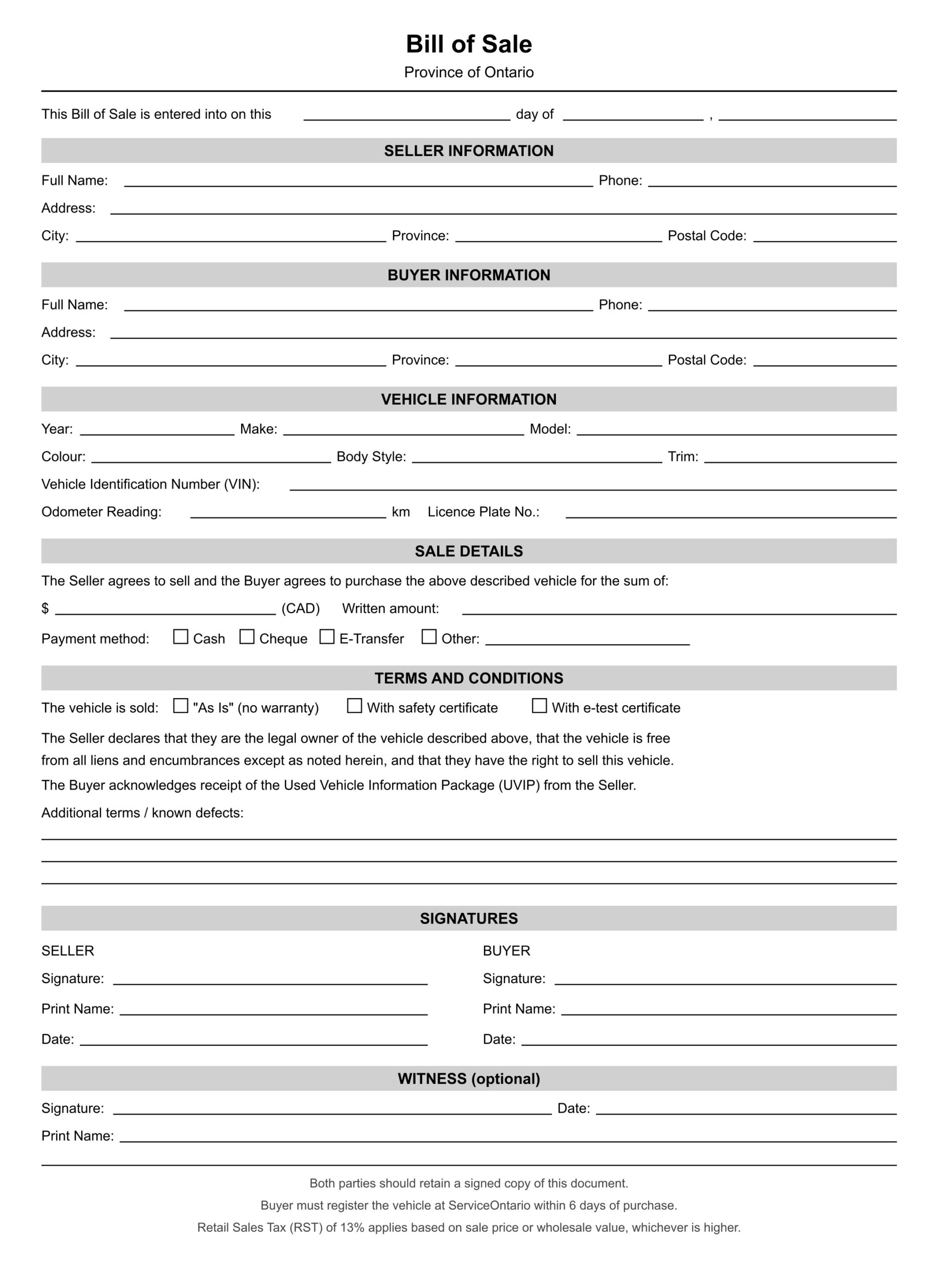
A Car bill of sale is a written legal document that records the transfer of ownership of a vehicle from a seller to a buyer. It contains the key details of the transaction: who sold the vehicle, who bought it, what was sold, how much was paid, and when the exchange took place.
In Ontario, a bill of sale is especially important in private sales (person-to-person), where there’s no dealership intermediary managing the paperwork. When you buy from a licensed dealer, they handle the documentation. In private deals, that responsibility falls on you.
Is a Bill of Sale Legally Required in Ontario?
Ontario does not mandate a bill of sale for every private vehicle sale. However, the Ontario Ministry of Transportation (MTO) strongly recommends it and for good reason. Without a bill of sale:
- You have no written proof of the purchase price (which affects how HST is calculated)
- You have no record of the condition of the vehicle at the time of sale
- You are more vulnerable to disputes, fraud, or liability after the fact
- You may face complications when registering the vehicle at ServiceOntario
A Template of Ontario Car Bill of Sale Includes
Why Does the Bill of Sale Matter?
1. Protects the Seller from Future Liability
Once you hand over the keys and money changes hands, you want a clean break. A signed bill of sale especially one that includes an “as-is” clause makes it clear that the buyer accepted the vehicle in its current condition. This can protect you if the buyer later claims the car had undisclosed problems.
2. Protects the Buyer’s Legal Rights
For the buyer, the bill of sale is proof that you legitimately purchased the vehicle. If the seller later denies the transaction, or if there’s a dispute over what was agreed upon, your signed document is your defense.
3. Establishes the Correct HST Calculation
In Ontario, when you register a used vehicle, you pay HST (13%) on the purchase price OR the wholesale value whichever is higher. Your bill of sale is the official record of what you paid. Without it, you have no documentation to back up your declared price.
4. Required for Registration at ServiceOntario
To transfer ownership and register the vehicle at a ServiceOntario location, you’ll typically need to present:
- A signed bill of sale
- Used Vehicle Information Package (UVIP) provided by the seller
- Safety Standards Certificate (if applicable)
- Proof of insurance
5. Helps with Insurance and Financing
Your insurance company or lender may request the bill of sale as proof of ownership and purchase price when setting up your policy or loan.
6. Creates a Paper Trail in Fraud Cases
Unfortunately, vehicle fraud does happen. A bill of sale creates a traceable record that can be critical if you discover the vehicle was stolen, had a lien on it, or was misrepresented.
How to Get an Ontario Car Bill of Sale
You have several options:
- ServiceOntario website – Ontario’s government site offers a generic bill of sale template that meets MTO requirements.
- Download a free template – Many reputable legal and automotive sites offer free printable Ontario bill of sale templates.
- Write your own – As long as it includes all required fields (listed above), a handwritten bill of sale is legally valid.
- Notarize it (optional) – For high-value vehicles, consider having the document notarized for an extra layer of protection.
Always complete the form in duplicate one copy for the buyer and one for the seller.
How to Write a Bill of Sale (Step-by-Step)
If you don’t have a template handy, you can create a valid bill of sale using nothing more than a plain sheet of paper and a pen. Here’s how to do it:
Step 1: Write a title at the top
Start with a clear heading such as “Bill of Sale” so the document’s purpose is obvious at a glance.
Step 2: Add the date
Write the exact date the sale is taking place.
Step 3: List the seller’s information
Include the seller’s full legal name, address, and phone number.
Step 4: List the buyer’s information
Do the same for the buyer – full legal name, address, and phone number.
Step 5: Describe the vehicle in detail
Write out the vehicle’s:
- Year, make, and model
- Color
- Vehicle Identification Number (VIN)
- License plate number (if still attached)
Step 6: Record the odometer reading
Note the exact mileage shown on the odometer at the time of sale.
Step 7: State the sale price
Write the agreed amount in both numbers and words (e.g., “$500 – Five Hundred Dollars”) to avoid any ambiguity.
Step 8: Add an “as-is” clause
If the car is being sold without warranty (common for older or scrap vehicles), include a line such as: “This vehicle is sold as-is, with no warranty expressed or implied.”
Step 9: Leave space for signatures
Both the buyer and seller should sign and date the bottom of the page. If possible, having a witness sign as well adds an extra layer of protection.
Step 10: Make two copies
Once signed, photocopy or photograph the document so both the buyer and seller each keep a copy for their records.
Final Checklist Before You Sign
Before completing any private car sale in Ontario, run through this quick checklist:
- Odometer reading recorded and matches dashboard
- Accurate sale price listed (no under-reporting)
- “As-is” clause included (if selling without warranty)
- Both buyer and seller have signed and dated the document
- Both parties have retained a copy
- Seller has provided the UVIP
- Safety Standards Certificate obtained (if required)
The Bottom Line
A car bill of sale in Ontario is more than just paperwork it’s your legal protection in a transaction that likely involves thousands of dollars. Whether you’re the buyer or the seller, taking 10 minutes to complete a proper bill of sale can save you from costly disputes, registration headaches, and unexpected tax bills down the road.
Don’t skip it. Don’t rush it. Do it right. If you are looking to scrap your car in Mississauga , we offer the best removal services in the regions.