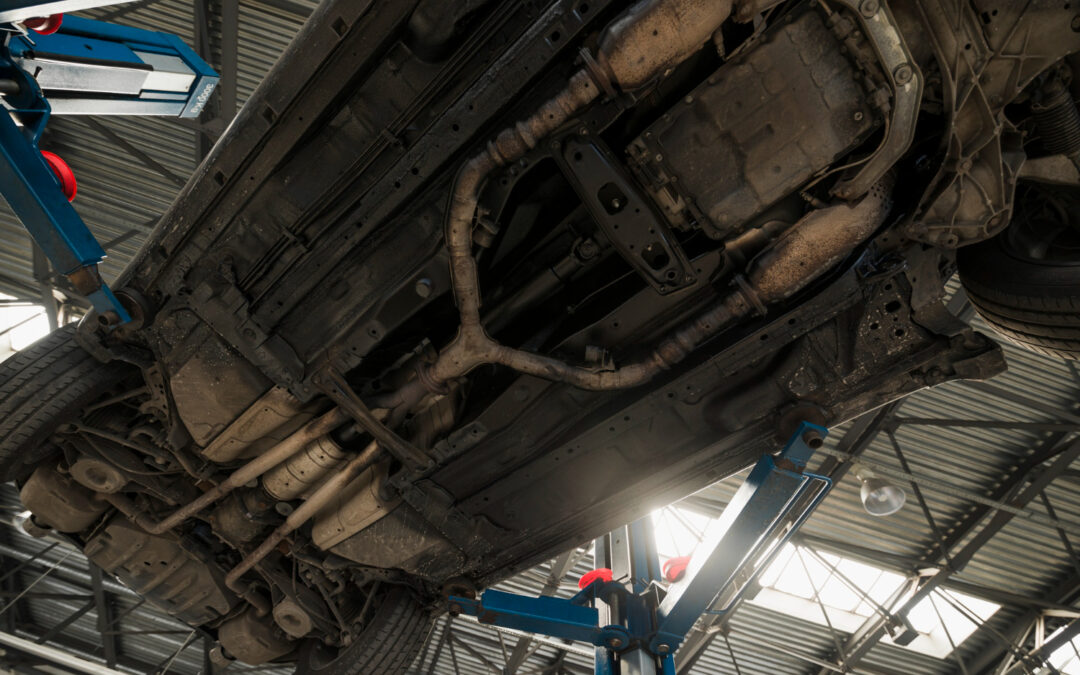
Your car has a small canister tucked into the exhaust system between the engine and the muffler. It’s roughly the size of a loaf of bread, it weighs a few kilograms, and it looks completely unremarkable from the outside. But it may be the single most valuable component on your entire vehicle worth anywhere from $100 to over $1,200 at scrap, depending on what’s inside it.
That component is the catalytic converter. And the reason people steal them off parked cars in the middle of the night and the reason a savvy scrap car buyer factors them carefully into every offer is the same: what’s hidden inside.
This guide explains exactly why catalytic converters hold so much value, what determines what yours is worth, and how that value flows through to you when you sell a scrap car in Mississauga.
What is a Catalytic Converter?
A catalytic converter is an emissions control device that sits in your vehicle’s exhaust system. Its job is to intercept the toxic gases produced by combustion carbon monoxide, unburned hydrocarbons, and nitrogen oxides and convert them into far less harmful compounds before they exit the tailpipe.
The conversion happens across a ceramic or metallic honeycomb substrate coated with a microscopic layer of precious metals. These metals act as catalysts. Without them, your engine emits nitrogen oxides, carbon monoxide, and hydrocarbons all harmful emissions. The precious metals trigger chemical reactions that transform these pollutants into far less harmful gases.
The requirements for these metals are extraordinary: they must withstand exhaust gas temperatures regularly reaching 400 – 800°C, with peaks exceeding 1,000°C. They must remain chemically stable in the presence of sulfur, phosphorus, zinc, and calcium. They must accelerate oxidation and reduction reactions rapidly at a molecular level, and remain effective for 100,000 – 150,000+ miles of operation over 10-15 years.
Only three metals on earth meet all of these requirements simultaneously. Those metals are what make a catalytic converter worth stealing and worth pricing carefully when you scrap a car.
The 3 Precious Metals Inside the Catalytic Converter
1. Platinum (Pt)
Platinum is known for its durability and high melting point. It’s commonly used in diesel catalytic converters, although some gas vehicles also contain platinum. Within the converter, it primarily handles the oxidation of carbon monoxide and unburned hydrocarbons, converting them into carbon dioxide and water vapor. A standard catalytic converter contains approximately 3-7 grams of platinum, though this varies significantly by model and vehicle type.
2. Palladium (Pd)
Petrol engines typically contain all three metals, while diesel units often rely primarily on platinum and palladium. Palladium has become the dominant precious metal in modern gasoline-engine converters over the past two decades, as manufacturers substituted it for platinum when platinum prices rose. As platinum prices rose in the past, manufacturers started using more palladium driving its demand and price upward. A typical gasoline converter contains roughly 3 -7 grams of palladium.
3. Rhodium (Rh)
Rhodium is the metal that most people have never heard of and the one responsible for catalytic converters’ sometimes extraordinary scrap value. Rhodium is the most expensive of the three and is used in very small amounts. It plays a vital role in reducing nitrogen oxide emissions. Even trace amounts can contribute significantly to a converter’s overall value.
2026 Precious Metal Prices – The Foundation of Converter Value
The scrap value of any catalytic converter traces directly back to the spot prices of these three metals on global markets. Here is where the three metals stand in 2026:
Platinum: As of 2026, platinum trades at approximately $900 – $1,100 per troy ounce, though prices fluctuate significantly. In February 2026, platinum surged past $2,300 per ounce during a broad precious metals rally.
Palladium: Palladium has traded as high as $2,900/oz historically, and currently sits in the $900 – $1,200/oz range in 2026.
Rhodium: Rhodium is the most valuable at approximately $9,500/oz as of early 2026, despite being the smallest component by weight only 1-2 grams per converter. Rhodium peaked above $29,000 per ounce in 2021, giving some idea of the ceiling these metals can reach.
How Much Does Your Specific Converter Worth
Luxury vehicles and SUVs generally contain higher concentrations of precious metals, which explains why some converters command substantially higher prices than others. A compact economy car and a full-size SUV can both have intact catalytic converters, but the SUV’s converter may contain two to three times as much PGM content by weight.
The type of vehicle and even the region where it was sold can make a big difference in what’s inside the converter. Gas vehicles typically have more palladium, whereas diesel vehicles may have more platinum. Hybrid vehicles often have higher rhodium content to meet stricter emission standards.
Therefore high-value converter types include those from the Toyota Prius (first and second generation), Ford F-250 diesel, and certain BMW and Mercedes models. These have become well-known in the scrap industry precisely because their PGM loadings are substantially above average.
How Converter Value Factors Into a Scrap Car Offer
When you sell a complete vehicle to a scrap car buyer in Mississauga or anywhere in the GTA, the catalytic converter is one of several components being priced. But it punches above its weight. Catalytic converters contain platinum, palladium, and rhodium, which can add $100–$500 to a vehicle’s scrap value depending on the converter type and vehicle make.
For a vehicle with an intact, OEM converter particularly a truck, SUV, or import model with known high PGM loading the converter can represent a meaningful share of the total offer you receive. A buyer who knows that a 2007 Honda Odyssey has a high-value foreign OEM converter, or that a 2006 Dodge Ram has a large domestic converter with good metal content, will incorporate that knowledge into a stronger offer.
For a buyer who doesn’t know or who applies a flat blended scrap rate to every vehicle regardless of converter type will systematically underpay for cars with high-value converters and shift that value to themselves. This is one of the clearest practical ways that experience and market knowledge in a scrap car buyer translates directly into dollars for the seller.
When you call for a quote, it’s worth mentioning:
- Whether the converter is original or has been replaced
- The make, model, and year of the vehicle (which allows the buyer to look up the known converter type)
- Whether the converter is intact and attached
This information takes 30 seconds to share and can meaningfully affect your offer.
Theft and What to Know in Ontario
Catalytic converter theft is a serious and ongoing problem across the GTA. The reason is straightforward: a thief with a battery-powered saw can remove a converter from beneath a parked car in under two minutes and sell it for $100–$600 cash. The risk-to-reward ratio, from a criminal perspective, has driven theft rates sharply upward in recent years.
You can take precautions against converter theft by installing a car alarm, ensuring your parking space is secure, or having the converter welded to the vehicle’s frame.
In Ontario, selling a catalytic converter separately from the vehicle it came from is technically legal but attracts scrutiny from reputable scrap yards, who are required to verify the seller’s identity and the converter’s provenance. Selling a stolen converter is a criminal offence, and Ontario’s scrap metal regulations require yards to keep records of purchases. So, if you’re selling your vehicle’s converter along with the rest of the car as part of a whole-vehicle scrap transaction, there are no complications the sale is straightforward and fully legitimate.
FAQs
Does my converter lose its precious metal content over time?
No. Catalytic converters do not lose their precious metals through normal operation. They lose catalytic activity due to surface poisoning and sintering, but the metal remains physically present and recoverable. An old, spent converter with poor emissions performance still has the same PGM content as when it was new.
Should I remove my catalytic converter before scrapping the car?
No removing it yourself and selling it separately adds complexity and, unless you know exactly what type of converter you have and which buyers will pay correctly for it, you may not net more money than including it with the whole vehicle sale. A reputable scrap car buyer with converter knowledge will already be pricing it in.
What is the most valuable converter type?
High-value types include converters from Toyota Prius first and second generation vehicles, Ford F-250 diesel, and certain BMW and Mercedes models. Luxury European SUVs Audi, BMW, Mercedes are also known for above-average PGM loadings and correspondingly strong scrap values.
Will catalytic converters still have value as electric vehicles become more common?
Yes stricter emissions regulations including tightened standards in major markets ensure strong PGM demand through at least 2030, giving the converter recycling industry a decade-plus of robust activity even as EV adoption accelerates. The transition will be gradual, and the current vehicle fleet will take decades to fully turn over.
If you have a scrap car lying in your house, get it scrapped in GTA areas- Mississauga, Brampton, Oakville, Etobicoke at the best prices.