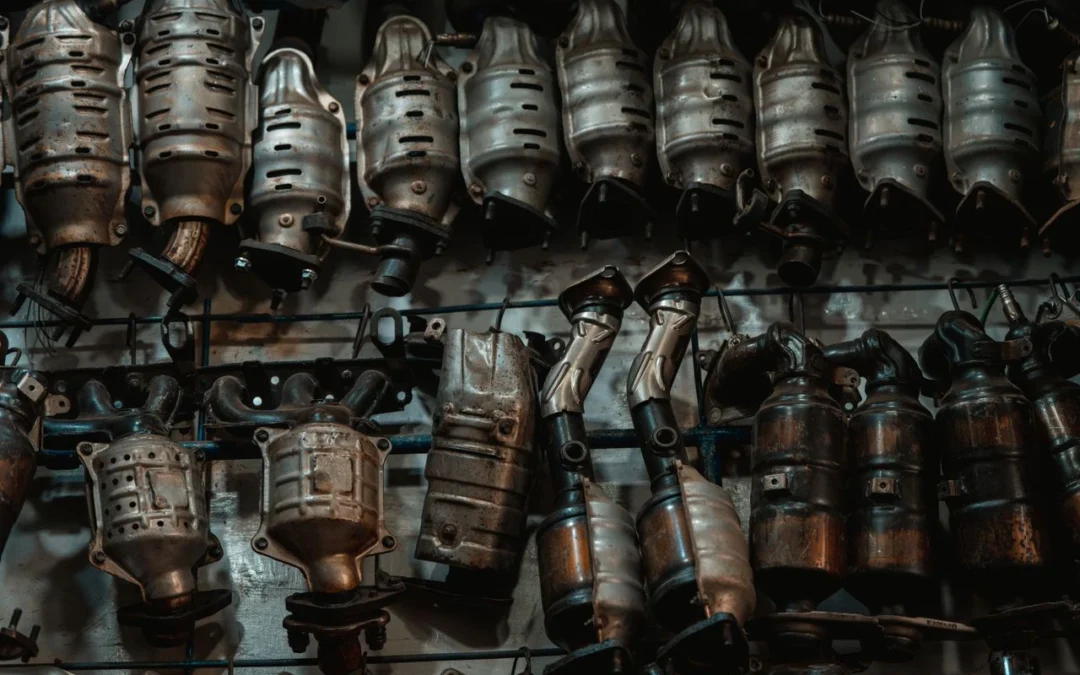
If you’ve ever pulled a catalytic converter off a junk car, you already know it’s not priced like your average piece of scrap metal. A rusted brake rotor is worth pennies. A catalytic converter, packed with the same footprint of metal, can be worth hundreds or even over a thousand dollars and the reason has nothing to do with steel.
This guide breaks down what drives catalytic converter scrap prices in 2026, what different vehicles are worth, and how to sell one without getting shorted.
Why Catalytic Converters Are Worth Money
A catalytic converter isn’t valuable because of the steel canister you can see — it’s valuable because of what’s packed inside it: a ceramic honeycomb coated in platinum, palladium, and rhodium (collectively called PGMs, or platinum group metals). These metals act as catalysts that convert toxic exhaust gases (carbon monoxide, nitrogen oxides, unburned hydrocarbons) into less harmful compounds like water vapor and CO2.
Scrap buyers price converters based on the live spot value of platinum, palladium, and rhodium, then apply a “payout percentage” (usually 40–70% of full metal content value, since they need margin for refining and risk).
| Metal | Spot Price (CAD/oz) |
|---|---|
| Palladium | ~CAD $1,710 – $1,765 |
| Rhodium | ~CAD $10,720 – $12,090 |
| Platinum | ~CAD $2,190 – $2,740 |
- Rhodium is the real prize- Ounce for ounce, it’s worth roughly 6–7x platinum and palladium combined, and even a few grams recovered from a single converter can swing its resale price by $100+.
- Palladium demand is tied to hybrids- Resilient hybrid vehicle demand has been offsetting expectations of a broader market surplus, which is part of why hybrid converters (like the Prius) stay valuable even as EV adoption grows.
- Prices are volatile daily – A converter worth $150 today might be worth $180 next week or $120 the week after, since pricing follows the spot market in real time.
Scrap Catalytic Converter Prices (Update 2026)
High-demand models push well past that, and large truck or diesel units add extra weight to the equation. While exact payouts vary by buyer and by the specific part number (there are thousands of converter variants), general patterns hold across the industry:
| Make/Model Tier | Examples | Typical Catalytic Converter Scrap Value (CAD) |
|---|---|---|
| Premium Hybrid Vehicles | Toyota Prius, Lexus Hybrid models, select Honda Hybrids | CAD $550–$1,275+ (rare models can exceed CAD $1,700) |
| Full-Size Trucks & SUVs (Domestic) | Ford F-150, Chevrolet Silverado, GMC Sierra | CAD $275–$850 (vehicles with dual catalytic converters may be worth CAD $700–$1,400+ combined) |
| Mainstream Japanese Sedans & SUVs | Toyota Camry, Toyota RAV4, Honda Civic, Honda CR-V, Nissan Altima, Nissan Rogue | CAD $140–$425 |
| European Luxury Vehicles | BMW, Mercedes-Benz, Audi, Porsche | CAD $350–$1,150+, depending on the model and engine |
| Economy & Budget Vehicles | Older Hyundai, Kia, Entry-Level Nissan Models | CAD $70–$210 |
| Diesel Trucks (DPF/DOC Equipped) | Ram Cummins, Ford F-250/F-350 Power Stroke, Chevrolet/GMC Duramax | CAD $700–$2,850+ for the complete DPF/DOC emissions unit, depending on size, condition, and precious metal content |
Estimated Scrap Value by Specific Vehicle (CAD, OEM converter, average condition)
These figures are compiled from Canadian and North American scrap-buyer price lists and are meant as ballpark ranges only the same model can vary by hundreds of dollars depending on model year, trim, and which of a vehicle’s (sometimes 2–3) converters you’re scrapping.
| Vehicle | Estimated Scrap Value (CAD) | Notes |
|---|---|---|
| Toyota Prius (Hybrid) | $700-$1,400+ | One of the highest-value OEM converters due to high platinum, palladium, and rhodium content. |
| Lexus Hybrid (RX, NX, ES, etc.) | $700-$1,300+ | High-value hybrid catalytic converters similar to the Prius. |
| Toyota Camry | $200-$500 | Standard OEM sedan converter with good recycling demand. |
| Toyota Corolla | $175-$400 | One of Canada’s best-selling cars with consistent OEM converter demand. |
| Toyota RAV4 | $200-$450 | Popular SUV with moderate-to-high converter value. |
| Toyota Highlander | $300-$600 | Larger SUV with higher-value catalytic converters. |
| Toyota Tacoma / Tundra | $300-$700 | Larger engines typically use larger catalytic converters. |
| Honda Civic | $175-$350 | Common benchmark for standard OEM catalytic converter pricing. |
| Honda Accord | $175-$350 | Similar value to the Civic, depending on model year. |
| Honda CR-V | $200-$450 | Compact SUV with slightly higher converter value. |
| Honda Pilot | $250-$500 | Mid-size SUV with larger catalytic converters. |
| Honda Odyssey | $250-$450 | Minivan with moderate converter value. |
| Ford F-150 | $350-$700 | Larger engines and some models feature dual catalytic converters. |
| Ford F-250 / F-350 (Diesel DPF/DOC) | $700-$2,500+ | Complete diesel emissions assembly can be highly valuable. |
| Ford Explorer | $300-$600 | Popular SUV; many models have multiple catalytic converters. |
| Ford Focus / Escape | $100-$250 | Compact car and crossover range. |
| Chevrolet Silverado | $350-$700 | Comparable to the Ford F-150. |
| Chevrolet Tahoe / Suburban | $400-$800 | Full-size SUVs often equipped with dual catalytic converters. |
| Chevrolet Equinox | $150-$350 | Common crossover with average OEM converter value. |
| Chevrolet Malibu / Cruze | $100-$250 | Standard passenger vehicle converter. |
| GMC Sierra 1500 | $350-$700 | Shares emissions components with the Silverado. |
| GMC Yukon | $400-$800 | Large SUV with multiple catalytic converters. |
| Ram 1500 | $250-$600 | Value varies by engine size and model year. |
| Jeep Grand Cherokee | $250-$500 | Mid-size SUV with moderate-to-high converter value. |
| Jeep Wrangler | $200-$450 | Value depends on engine size and model year. |
| Nissan Altima / Rogue | $150-$350 | Common Japanese vehicles with average converter value. |
| Nissan Sentra | $100-$225 | Entry-level sedan with a smaller catalytic converter. |
| Subaru Forester / Outback | $200-$450 | Moderate value depending on engine and model year. |
| Subaru Crosstrek | $200-$400 | Popular Canadian crossover with steady recycling demand. |
| Mazda3 / Mazda6 | $150-$300 | Standard OEM catalytic converter pricing. |
| Mazda CX-5 | $200-$400 | Popular SUV with moderate converter value. |
| BMW 3 Series | $300-$700 | Higher precious metal loading to meet European emissions standards. |
| BMW X5 | $600-$1,100 | Luxury SUV with larger catalytic converters. |
| Mercedes-Benz E-Class | $350-$800 | Premium European vehicle with above-average PGM content. |
| Audi A4 | $300-$700 | Comparable to BMW and Mercedes-Benz sedans. |
| Volkswagen Jetta | $150-$350 | German compact sedan with moderate precious metal loading. |
| Volkswagen Tiguan | $200-$450 | Compact SUV with slightly higher value than the Jetta. |
| Hyundai Elantra | $100-$250 | Common compact sedan with moderate converter value. |
| Hyundai Tucson | $150-$350 | Popular compact SUV. |
| Kia Rio | $75-$175 | Lower-value OEM converter due to smaller precious metal loading. |
| Kia Sportage | $150-$350 | Similar value to the Hyundai Tucson. |
| Aftermarket Converter (Any Make) | $15-$75 | Contains significantly less precious metal than OEM catalytic converters. |
Most catalytic converters are worth somewhere between about $75 and $800, with the exact number depending on the car’s make, model, and whether it’s an OEM or aftermarket unit, and bigger converters from trucks and SUVs generally carry more precious metal than the smaller units found in compact cars.
Most Valuable Converters on the Road
A handful of models consistently top scrap price lists because of unusually high PGM loading:
Toyota Prius (2004-2015)
Hybrid drivetrains cycle the engine on and off, which reduces heat-related degradation of the catalyst coating. Combined with a rhodium-rich formula, these are the single most targeted converter for theft and among the most valuable for scrap.
Ford F-250/F-350 diesel
Large diesel particulate and oxidation systems mean more raw metal per unit, even without rhodium.
Toyota Tundra
A large V8 converter with a heavy PGM load.
Honda Accord (2003-2015)
Uses a palladium blend that recovers particularly well during refining.
Luxury and European models (BMW, Mercedes, Audi SUVs)
Larger engines and stricter emissions tuning tend to mean higher metal content across the board.
What Determines the Price of Your Catalytic Converter
1.Precious metal loading
This is the whole ballgame. Two converters that look nearly identical can be worth wildly different amounts depending on the exact platinum, palladium, and rhodium mix used by the manufacturer.
2. Converter type
OEM (factory-original) converters almost always carry more precious metal than aftermarket replacements, which are built to meet emissions standards at a lower cost. Aftermarket units can be worth as little as $5 to $50.
3. Fuel type
Gasoline three-way converters use all three PGMs. Diesel systems typically use only platinum, which caps their upper value regardless of size.
4. Condition
A converter with a legible stamped serial number, an unbroken ceramic core, and no signs of it being drilled or gutted will always quote higher cutting one open to “check” it destroys recoverable material and tanks its value.
5. Vehicle make, model, and year
This is really a proxy for PGM loading certain manufacturers and model years are known quantities to buyers, who quote directly against a database keyed to the stamped part number.
Should you remove the converter before selling a Junk Car?
Generally, most junk car and salvage car buyers already factor the converter into their total offer for the vehicle. If you remove it yourself, expect the offer for the rest of the car to drop by roughly $200 to $500 the buyer is just accounting for the part that’s now missing. Unless you already have a specific converter buyer lined up who’s paying a clear premium, it’s usually simpler, and often more profitable overall, to sell the vehicle whole.
Where and How to Sell in Canada
| Option | Pros | Cons |
|---|---|---|
| Licensed scrap metal yard | Fast cash, local, no shipping | May pay lower percentage of true value |
| Specialized cat-buying networks (online quote + shipping) | Often better prices, serial-number-based quotes | Wait time for payment, shipping hassle |
| Auto recyclers / junkyards | Convenient if selling a whole vehicle | Cat value may be bundled into vehicle price |
| Private sale (marketplace listings) | Potentially highest price | Higher scam risk, no guarantee of a fair market rate |
Regardless of channel, reputable buyers price based on live PGM spot rates, not flat “one price fits all” numbers be wary of anyone offering a fixed price without asking for your part number.
Selling Catalytic Converter Legally
Converter theft surged from 2023, and most states responded with tighter rules around scrap sales. As of 2026, the typical requirements include:
- Proof of ownership (title or registration) in most states
- Valid photo ID required almost everywhere converters are bought
- Waiting periods before payment in some states
- Business or scrap dealer licensing for sellers in a handful of jurisdictions
A legitimate buyer will always ask for ID. If a buyer offers cash with no questions asked, that’s a red flag, not a good deal.
Tips for getting the best price
- Keep the serial number readable- Buyers price against a database tied to the exact stamped code — a missing or ground-off number almost always lowers the offer.
- Don’t cut it open- Sell it whole and intact; gutting it destroys the recoverable coating.
- Get more than one quote- Because pricing is based on daily PGM spot rates, quotes can vary meaningfully between buyers on the same day.
- Check current metal prices before you sell- A quick look at platinum, palladium, and rhodium spot prices gives you a sanity check against any quote you receive.
The Bottom Line
Catalytic converter scrap value in 2026 comes down to one thing: how much platinum, palladium, and rhodium is packed inside, and what those metals are trading for that day. Sell to a specialist, keep the unit intact, and bring proper ID and documentation and you’ll get a fair number for what’s easily the most valuable part left on a dead car.
Precious metal prices referenced in this guide are approximate 2026 spot figures and fluctuate daily. Always confirm current metal rates and your state’s specific sale requirements before selling.